G2 Blog Series: Building the Future of Ambulatory Care: The Eight Pillars of a High-Performing Strategy
Healthcare delivery is being redefined.
Advances in clinical technology, changing reimbursement models, workforce pressures, and rising consumer expectations are accelerating the migration of care beyond the traditional hospital. At the same time, health systems are being challenged to improve access, strengthen financial performance, enhance the patient experience, and build stronger physician partnerships—all while delivering consistently high-quality care.
For many organizations, the response has been to expand ambulatory services. But successful ambulatory strategies are about far more than opening another ambulatory surgery center or adding an urgent care location. The organizations leading this transformation recognize that every site of care—from hospitals and ASCs to imaging centers, medical office buildings, physician practices, and urgent care centers—must function as part of an intentionally designed, integrated network.
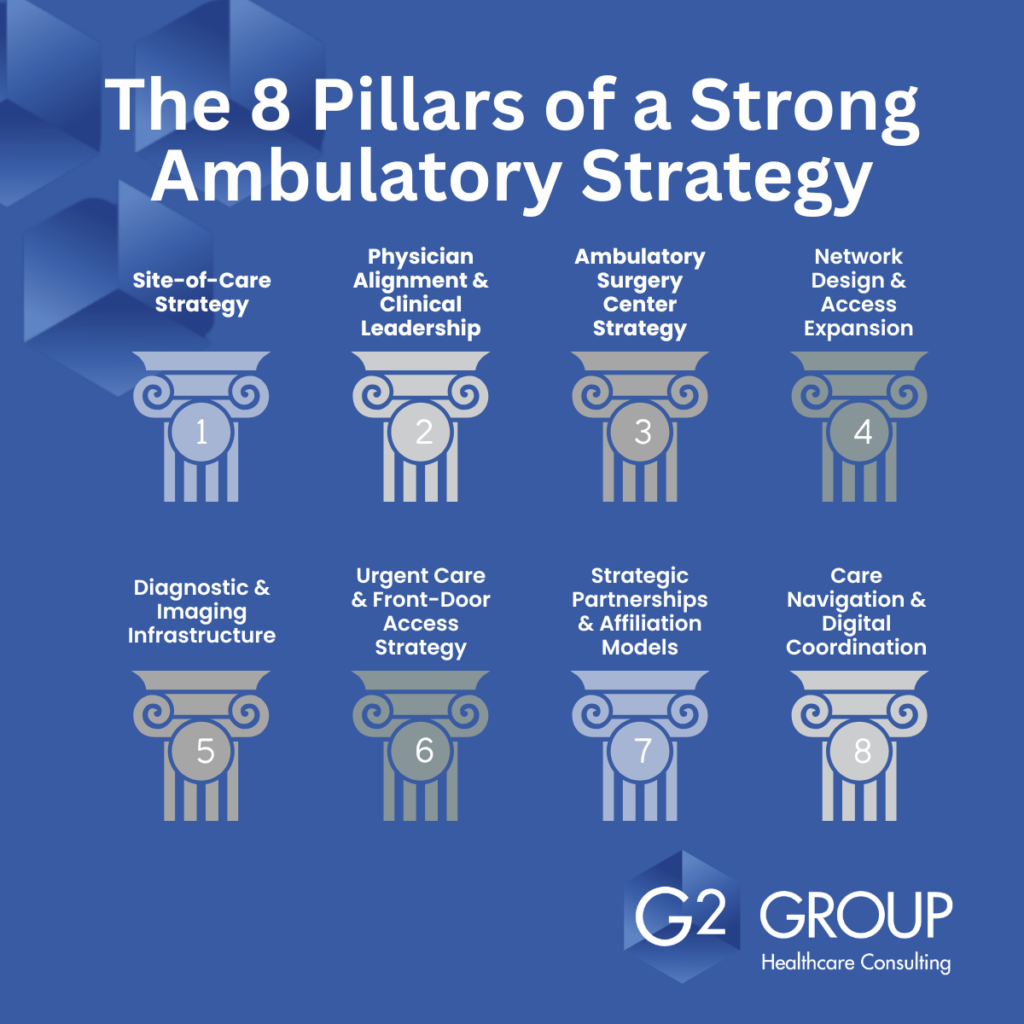
Over the next several weeks, we’ll take a deeper dive into the eight pillars that form the foundation of a successful ambulatory strategy. Together, these capabilities help health systems align clinical care, operations, physician engagement, and patient access to create a more connected, efficient, and sustainable model of care.
1. Site-of-Care Strategy
A successful ambulatory platform begins with clear criteria for where care should occur.
Health systems must intentionally determine which services belong in:
- Hospitals
- ASCs
- Medical office settings
- Urgent care and community sites
Without clear site-of-care governance, organizations risk inefficiencies, internal competition, and margin erosion.
2. Physician Alignment & Clinical Leadership
Ambulatory strategies only succeed when physicians are aligned around them.
This includes:
- Shared incentives
- Clinical governance
- Participation in site-of-care decisions
- Strategic partnerships with independent physicians
Physicians are not just users of ambulatory platforms—they are central architects of them.
3. Ambulatory Surgery Center Strategy
ASCs are often the anchor of ambulatory growth.
Leading systems view them not simply as procedural facilities but as:
- access expanders
- efficiency drivers
- physician partnership platforms
- strategic “front doors” into the broader health system
The key is determining the right ownership structure, service mix, and geographic placement.
4. Network Design & Access Expansion
Ambulatory care allows systems to extend their footprint into the communities they serve.
Strategic network design considers:
- geographic coverage
- patient travel patterns
- referral pathways
- population growth trends
The goal is simple: bring the right care closer to where patients live and work.
5. Diagnostic & Imaging Infrastructure
Imaging and diagnostics are often the operational backbone of ambulatory care.
Efficient outpatient networks rely on:
- accessible imaging
- coordinated scheduling
- streamlined referral pathways
- integrated diagnostic services
When designed well, diagnostics support both clinical quality and operational efficiency across the entire system.
6. Urgent Care & Front-Door Access Strategy
Urgent care centers and other access points increasingly serve as entry points into the health system.
These sites can:
- redirect appropriate care away from emergency departments
- introduce new patients to the system
- improve access and convenience
When integrated with the broader network, they strengthen both patient experience and system utilization.
7. Strategic Partnerships & Affiliation Models
Not every ambulatory asset must be owned outright.
Forward-looking systems are developing partnerships with:
- independent physician groups
- specialty providers
- community organizations
- regional healthcare partners
These models allow systems to expand access, strengthen physician relationships, and scale services without unnecessary duplication.
8. Care Navigation & Digital Coordination
Patients rarely experience care within a single building.
Navigation, scheduling coordination, and digital tools are critical to helping patients move seamlessly across sites of care.
Effective navigation systems ensure:
- the right service
- in the right location
- at the right time
This pillar is where operational design meets patient experience.
No two health systems will build their ambulatory networks in exactly the same way. Market dynamics, physician relationships, community needs, and organizational priorities all shape the path forward. But the principles behind successful ambulatory growth are remarkably consistent.
Throughout this series, we’ll explore each of these eight pillars in greater depth—from physician-hospital alignment and site-of-care strategy to network design, digital coordination, and strategic partnerships. Along the way, we’ll share insights, practical considerations, and questions healthcare leaders should be asking as they prepare their organizations for the next generation of care delivery.
The future of healthcare won’t be defined by a single facility. It will be shaped by how effectively health systems connect people, places, physicians, and services into one coordinated network. Those who build with intention today will be best positioned to deliver exceptional care—and compete successfully—in the years ahead.