Network Design & Access Expansion: Building the Right Ambulatory Network for the Market
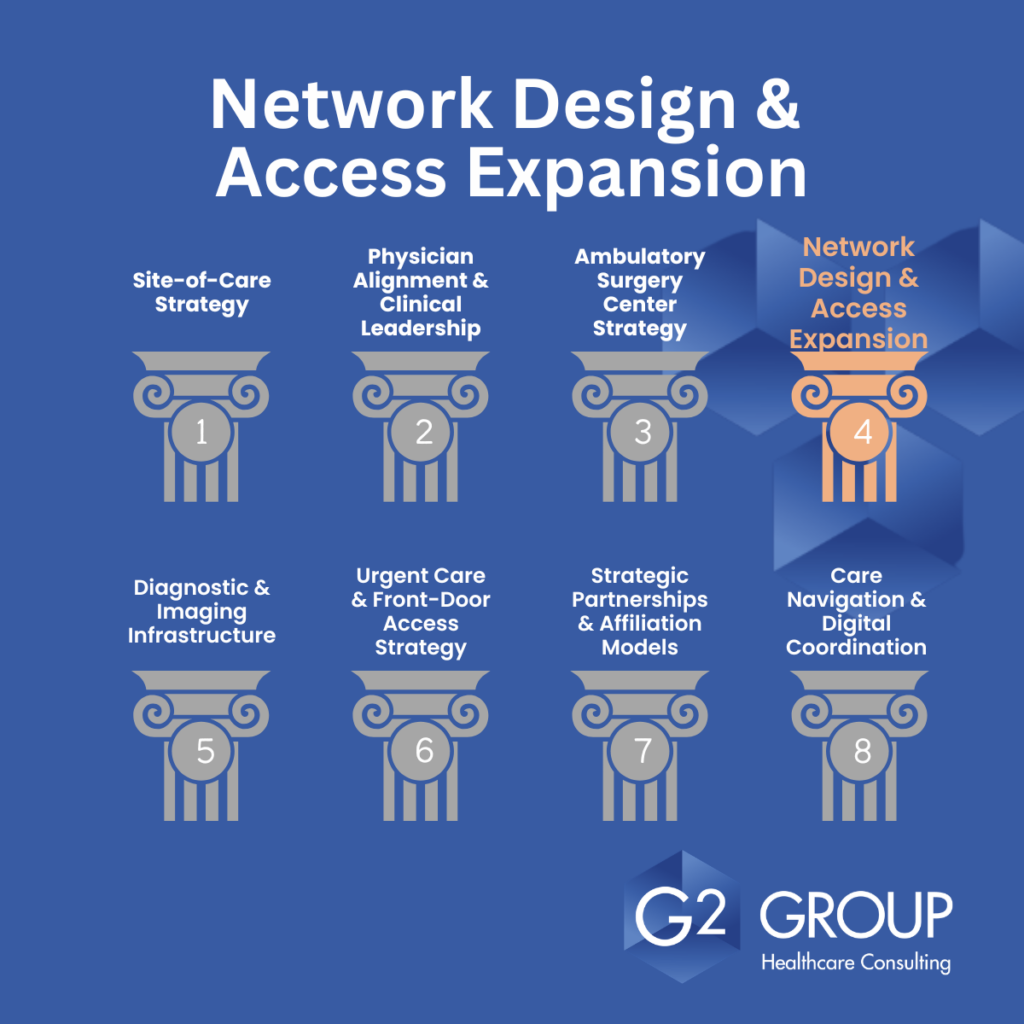
Ambulatory growth is often measured in facilities: How many ASCs do we have? How many urgent care locations? How much medical office space?
But the more important question is different:
Does the network make it easier for patients to access the right care?
As more services move beyond the hospital, health systems have an opportunity to rethink not just where they provide care, but how their entire network functions together. A successful ambulatory strategy extends the health system’s reach into the communities it serves while creating a more intentional path for patients to access services t.
That requires more than adding locations. It requires network design.
From Facilities to a Network
Historically, healthcare growth has often been organized around individual facilities. A hospital expands, a medical office building is developed, an ASC is added, or an urgent care opens in response to a specific market opportunity.
That approach can create access—but it can also create fragmentation.
A stronger strategy considers each location as part of a larger network.
Hospitals, ASCs, physician practices, imaging centers, urgent cares, freestanding emergency departments, and other community-based sites each serve a different purpose. The objective is not to make every location offer everything.
It is to determine what each location should do, who it should serve, and how it should connect to the rest of the system.
When those decisions are made together, the network becomes greater than the sum of its individual sites.
Geography Is a Strategic Decision
Where care is delivered matters.
Patients increasingly value convenience, but convenience means more than simply being “closer.” Travel time, traffic patterns, parking, proximity to home or work, and the availability of other services all influence where patients choose to receive care.
For health systems, this makes geographic strategy an important part of ambulatory planning.
Questions worth asking include:
- Where are current patients traveling from?
- Where are patients leaving the system to receive care?
- Which communities are growing?
- Where are physician practices concentrated?
- Where are there gaps in access?
- How does our current footprint compare with competitors?
- Which services need to be closer to patients?
The answers can reveal opportunities that aren’t obvious when facilities are evaluated individually.
Population Growth Should Shape the Network
Today’s demand isn’t necessarily tomorrow’s demand.
Population growth, demographic changes, employer expansion, housing development, and shifts in community composition can all change healthcare needs over time.
A location that appears adequate today may become a significant access constraint five years from now. Conversely, investing heavily in a market with limited sustainable demand can create unnecessary capacity and financial pressure.
Forward-looking network design therefore considers where population is going—not just where it is today.
This is particularly important for health systems evaluating new ambulatory sites, relocations, expansions, or partnerships.
The goal isn’t to predict the future perfectly.
It’s to make strategic decisions with the future in mind.
Referral Pathways Are Part of Network Design
A geographically convenient facility isn’t particularly valuable if patients and physicians don’t know how to access it.
Referral pathways are an often-overlooked component of ambulatory strategy.
A well-designed network considers how a patient moves from:
Primary care → Specialist → Diagnostic services → Procedure → Follow-up
That journey may involve several locations.
If those locations aren’t connected operationally, patients can encounter unnecessary delays, duplicate testing, confusing scheduling processes, or unclear next steps.
Network design must therefore go beyond geography.
It must consider connectivity.
The best ambulatory networks make it easier for physicians to refer patients appropriately and easier for patients to navigate what comes next.
Not Every Location Should Serve Every Patient
One of the most important principles of network design is recognizing that different communities have different needs.
A growing suburban market may require expanded primary and specialty access.
Another market may have stronger demand for imaging and diagnostics.
A mature market with a high concentration of specialists may support an ASC or specialty-focused ambulatory platform.
The right answer isn’t always a full-service facility.
In fact, trying to replicate the same services at every location can create unnecessary duplication, increase costs, and make the network harder to manage.
Strategic differentiation between sites can be a strength.
The question is what combination of services creates the greatest value for patients and the system.
Every Location Is a Front Door
One of the most important shifts in ambulatory strategy is recognizing that the “front door” of a health system is no longer necessarily the hospital.
A patient may enter the system through an urgent care.
Another may begin with an imaging appointment.
A physician practice may be the starting point for a surgical journey.
An ASC may be the first meaningful interaction a patient has with the organization.
Each of these sites creates an opportunity to establish a relationship and connect patients to the broader network.
That makes every ambulatory location both a care delivery site and a strategic access point.
The experience at that front door matters.
Access and Economics Have to Work Together
Expanding access is an important goal—but access without a sustainable operating model isn’t a strategy.
Every new location represents capital, staffing, technology, maintenance, and ongoing operational requirements.
That means network decisions should consider both sides of the equation:
What does the community need?
and
What can the health system sustainably support?
The strongest networks balance patient demand, clinical appropriateness, market opportunity, physician capacity, payer dynamics, and financial performance.
That balance is particularly important as care continues migrating toward lower-cost settings.
Designing the Network Around the Patient
Ultimately, network design comes down to a simple principle:
Put the right care in the right place for the right population.
That may mean a complex procedure remains at the flagship hospital.
It may mean a routine procedure moves to an ASC.
It may mean imaging is brought closer to a growing community.
It may mean an urgent care becomes the first point of access for patients who otherwise might turn to the emergency department.
There is no single model that works for every health system.
But there is a common opportunity: designing a network intentionally rather than allowing it to evolve one facility at a time.
Looking Ahead
The ambulatory network of the future won’t necessarily be the one with the most locations.
It will be the one where locations have a purpose, services are connected, physicians understand the pathways, and patients can move through the system with less friction.
As health systems increasingly expand beyond the hospital, network design becomes a strategic discipline—not simply a real estate exercise.
The question for leaders is no longer just “Where should we build?”
It’s “What network do our patients, physicians, and communities need us to build—and how should each part work together?”
That is where ambulatory expansion becomes true strategic growth.
G2 Group can help with this challenge. Let’s do an introductory call to discuss our approach.