Ambulatory Surgery Center Strategy: From Procedural Facility to Strategic Growth Platform
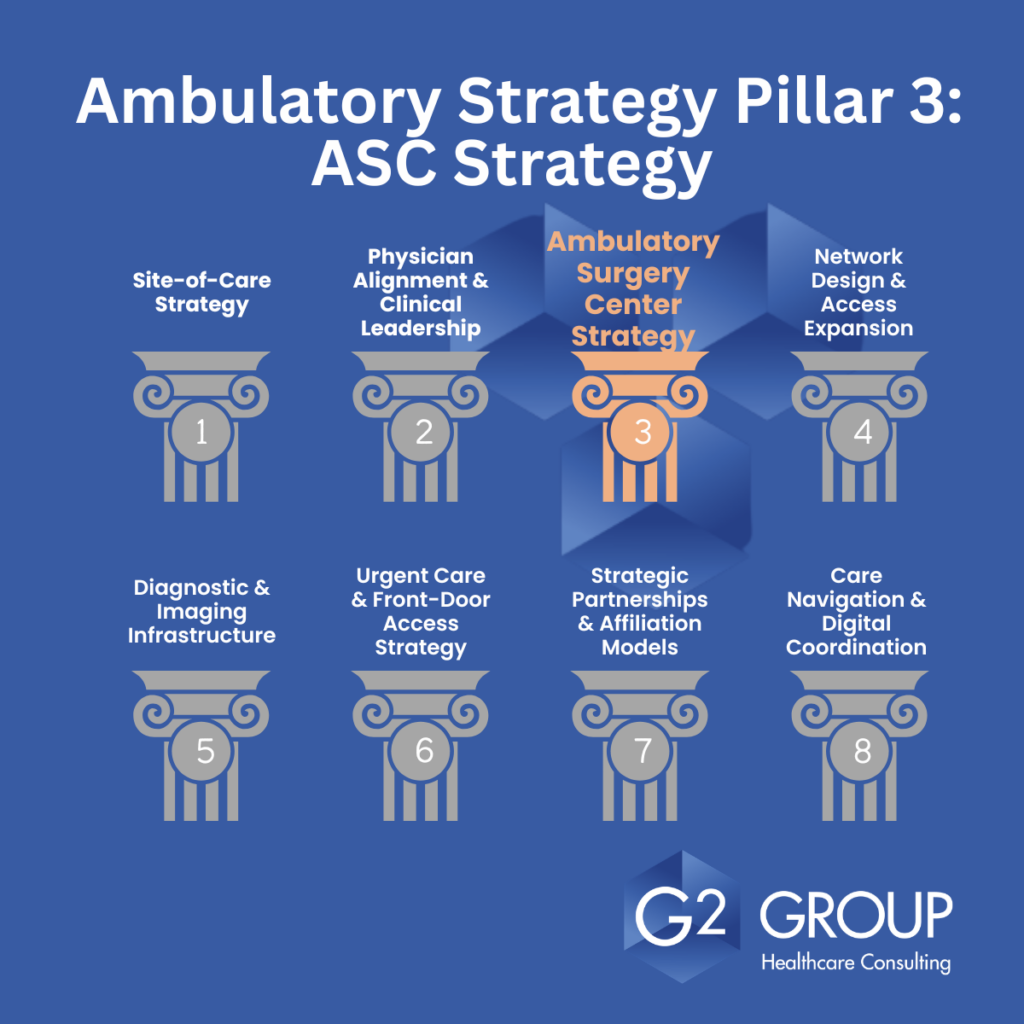
Few assets have had a greater impact on healthcare’s ambulatory transformation than the Ambulatory Surgery Center (ASC).
What was once viewed primarily as a lower-cost alternative to the hospital operating room has evolved into something much more significant. Today, ASCs sit at the intersection of patient access, physician alignment, operational efficiency, and long-term growth strategy.
For many health systems, ASCs have become the anchor of ambulatory expansion.
The question is no longer whether ASCs should play a role in an organization’s future. The question is how to design an ASC strategy that advances broader system goals while meeting the evolving needs of patients, physicians, and payers.
The ASC Evolution
The continued migration of procedures to outpatient settings is one of the most significant shifts in modern healthcare delivery.
Advances in technology, anesthesia, minimally invasive techniques, and postoperative care have expanded the range of procedures that can be performed safely outside the hospital. At the same time, patients increasingly prefer convenient locations, shorter stays, and recovery closer to home.
Payers have accelerated this trend by encouraging care in lower-cost settings whenever clinically appropriate.
As a result, ASCs are no longer a niche component of healthcare delivery. They have become an essential part of how health systems manage capacity, improve access, and compete in increasingly dynamic markets.
Beyond Efficiency: The Strategic Value of ASCs
Much of the ASC conversation focuses on efficiency—and for good reason.
ASCs often provide:
- Streamlined operations
- Predictable scheduling
- Lower costs of care
- Improved patient convenience
- Faster throughput
But focusing solely on efficiency understates their strategic value.
Leading health systems increasingly view ASCs as:
Access Expanders
ASCs allow organizations to bring services closer to where patients live and work.
Rather than requiring patients to travel to a hospital campus, systems can provide high-quality procedural care in locations that are more convenient for patients and families.
This not only improves patient satisfaction but can strengthen market presence and referral relationships throughout a region.
Physician Partnership Platforms
For physicians, ASCs represent an opportunity to improve efficiency, participate in governance, and help shape care delivery models.
Whether through joint ventures, co-management arrangements, or other partnership structures, ASCs often serve as a vehicle for stronger physician-hospital alignment.
These partnerships can create shared accountability around quality, patient experience, and operational performance while supporting long-term physician engagement.
ASCs are also a pivotal recruitment component for supplementing compensation plans under a competitive employment environment. Some systems choose to not allow ASC ownership while others allow ownership in their system ASC making for a compensation plan pressures.
Strategic Front Doors
One of the most overlooked aspects of ASC strategy is their role as an entry point into the broader health system.
A patient may initially visit an ASC for a single procedure, but that interaction can introduce them to a wider network of services, specialists, and providers.
When integrated effectively, ASCs become more than procedural facilities—they become gateways into lifelong patient relationships.
The Importance of Getting the Structure Right
Not every ASC strategy looks the same.
Successful organizations carefully evaluate several key considerations before moving forward:
Ownership Structure
Should the ASC be wholly owned by the health system?
Should physicians participate as owners?
Is a joint venture the right model?
The answers depend on market dynamics, physician relationships, capital requirements, and long-term strategic objectives.
The right ownership structure can strengthen alignment and accelerate growth. The wrong one can create friction and limit future opportunities.
Service Mix
Not every procedure belongs in an ASC.
Organizations must thoughtfully evaluate which specialties and procedures are best suited for the outpatient environment based on clinical appropriateness, patient safety, demand, and financial performance.
The most successful ASC strategies align service offerings with broader system goals rather than simply pursuing procedural volume.
Many ASC now perform Total Joint Replacement, Spine procedures and Cardiovascular cases in Cath Labs. Recent additions to the allowable ASC cases in CMS regulations further make these service lines consider strategic timing, placement, case selection and coordination. These are high margin cases that health systems will not be able to fully control their migration to ASCs.
Geographic Placement
Location remains one of the most important strategic decisions.
The best ASC locations are rarely selected based solely on available real estate.
They are chosen based on:
-
- Patient demand
- Population growth
- Physician presence
- Referral patterns
- Competitive dynamics
- Existing network assets
A well-positioned ASC can strengthen a health system’s presence in an underserved market while improving convenience and access for patients.
Integration Matters More Than Expansion
One of the biggest mistakes organizations make is viewing ASCs as standalone facilities.
Successful ambulatory strategies integrate ASCs into the broader care continuum and service line plan.
That means connecting them to:
-
- Physician practices
- Imaging and diagnostics
- Care navigation resources
- Digital scheduling platforms
- Hospital-based services when higher-acuity care is required
- Post discharge support including rehabilitation and home/remote care
Patients do not think in terms of facilities. They think in terms of their healthcare journey.
The more seamlessly ASCs are connected to the broader network, the better that journey becomes.
Looking Ahead
The role of the ASC will continue to expand as healthcare shifts toward more distributed, consumer-focused models of care.
But success won’t come from simply building more facilities.
The organizations that thrive will be those that view ASCs as part of a larger ambulatory ecosystem—one designed to align physicians, improve access, strengthen patient relationships, and support sustainable growth.
In that sense, ASCs are no longer just surgical facilities; They are strategic assets that help define how health systems compete, grow, and deliver care in the future.
Next in our Pillars of Ambulatory Strategy series: Network Design & Access Expansion—how leading health systems create connected ambulatory networks that improve patient access, strengthen market presence, and support long-term growth.