G2 Blog Series: 8 Pillars of Ambulatory Strategy: Pillar 1: Site-of-Care Strategy
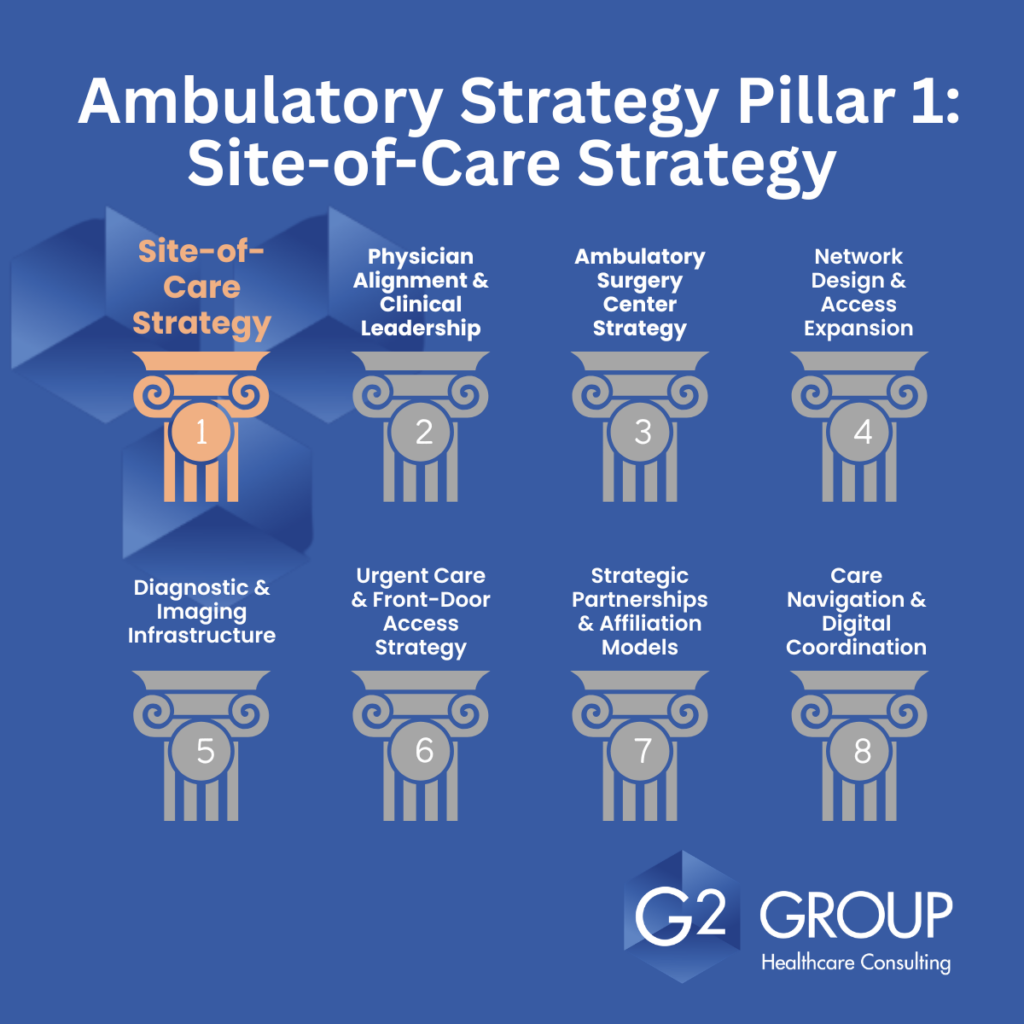
Site-of-Care Strategy: A Foundational Pillar of Ambulatory Excellence
A successful ambulatory care platform doesn’t emerge by accident—it’s built through careful, intentional decisions about where care should occur. In today’s dynamic healthcare landscape, clarity around site-of-care strategy separates high-performing health systems from those struggling with duplication, inefficiency, and internal margin friction.
At its core, a site-of-care strategy defines the logic behind placement: which services are best suited for hospitals, ambulatory surgery centers (ASCs), medical office buildings, or community-based sites like urgent care centers. Each site offers unique operational advantages and clinical capabilities, and getting that alignment right is a strategic—not logistical—exercise.
Hospitals remain critical for high-acuity and complex care where inpatient resources, technology, and multidisciplinary teams are essential. Moving procedures or interventions outside the hospital only makes sense when patient safety and outcomes can be maintained—or improved—in lower-cost environments. ASCs, for example, have proven their ability to deliver high-quality surgical care with remarkable efficiency. But they work best when integrated into a system-wide plan, not as isolated entrepreneurial ventures competing with hospital ORs.
Medical office settings play another important role: they are where longitudinal relationships are built and care is coordinated. When effectively positioned, they become the connective tissue that binds specialty, procedural, and diagnostic care together. Meanwhile, urgent care and neighborhood clinics expand reach into communities, providing convenience and access that align with contemporary consumer expectations.
Yet, despite the apparent logic of these placements, many health systems operate without defined criteria governing site-of-care decisions. The absence of that governance often manifests in fragmented growth: overlapping service lines, underutilized facilities, and thin margins stretched across competing internal entities. In such ecosystems, competition occurs not with other health systems—but within the same organization.
The antidote is disciplined clarity and strategic planning for the ambulatory services that integrate across service lines . Site-of-care governance should be rooted in data on:
- Clinical throughput,
- Cost-to-serve,
- Patient experience
- Geographical saturation.
When service distribution follows a transparent enterprise framework—not merely individual department preferences—resources are optimized, volumes are strategically directed, and care delivery becomes predictably sustainable.
A well-defined site-of-care strategy does more than reduce inefficiency; it creates the foundation for consistency across the ambulatory continuum. It ensures that every new campus, ASC, or outpatient facility reinforces the health system’s overall mission and brand promise across the service line continuum and distributed across the market.
In an era where ambulatory expansion is both an opportunity and a risk, success depends on asking not just where we deliver care, but why we deliver it there.
If your ASC strategy isn’t integrated with your service line plans, there will be a huge disconnect. G2 Group can help with this challenge. Let’s do an introductory call to discuss our approach.