Diagnostic Imaging Infrastructure: The Foundation of a Connected Ambulatory Network
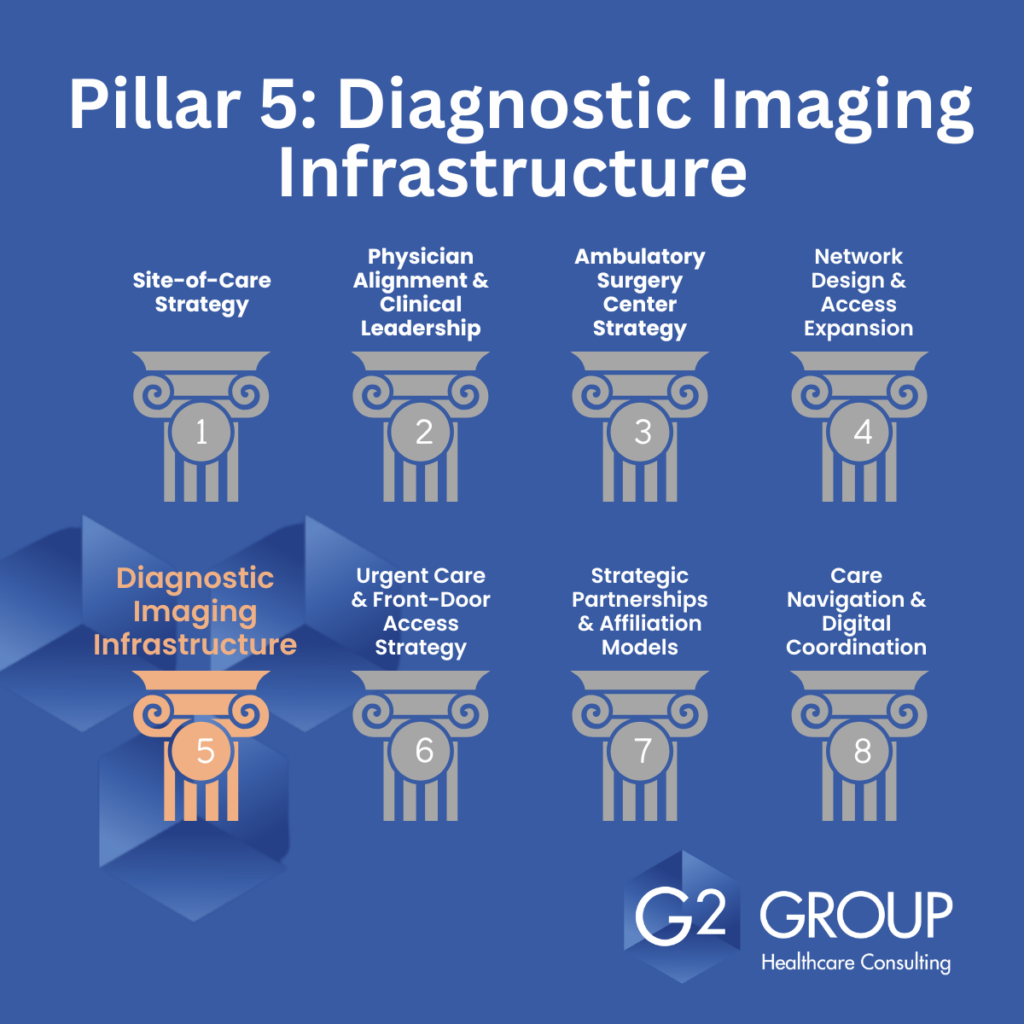
As health systems expand their ambulatory footprint, much of the focus is placed on high-profile investments such as ambulatory surgery centers, specialty practices, and urgent care networks. Yet some of the most important components of a successful ambulatory strategy are the services that support nearly every stage of the patient journey: diagnostic imaging.
Imaging and diagnostics are more than supporting services. They influence clinical decision-making, physician productivity, patient access, referral patterns, and the overall efficiency of care delivery. When strategically positioned and effectively integrated, they can strengthen the entire ambulatory network.
For health system leaders, the challenge is not simply determining where to add imaging capacity. It is understanding how these diagnostic services fit into the broader delivery model—and how they can improve access, support growth, and create a more coordinated patient experience.
Diagnostics Are a Strategic Asset, Not Just a Support Service
Diagnostic imaging and testing are often viewed as downstream services, supporting decisions made in primary care, specialty practices, emergency departments, and surgical settings. In reality, they are a central component of how patients move through the healthcare system.
A delay in imaging can extend the time to: 1) get a clinical diagnosis, 2) initiate treatment, or 3) perform a necessary procedure. Limited access to diagnostic services can also contribute to referral leakage when patients seek more convenient options outside the health system.
Conversely, accessible and well-coordinated diagnostic services can help physicians make timely clinical decisions, reduce unnecessary delays, and improve continuity of care.
As health systems continue to distribute services across hospitals, medical office buildings, ASCs, and community-based locations, diagnostic imaging must be considered an integral part of network planning—not an afterthought.
Location and Accessibility Matter
Convenience is an increasingly important factor in where patients choose to receive care. For imaging services, accessibility can directly influence whether patients complete recommended testing and how efficiently they progress through treatment.
Health systems have an opportunity to rethink where imaging services are located in relation to physician practices, population centers, and other ambulatory facilities.
Effective planning considers:
- Geographic demand: Understanding where patients live, work, and currently travel for imaging services.
- Physician proximity: Locating services in ways that support primary care and specialty practices while reducing unnecessary travel.
- Service availability: Matching imaging modalities and capabilities to the needs of the surrounding population.
- Market dynamics: Evaluating competing facilities, referral patterns, population growth, and opportunities to improve access.
Not every community requires a full-service imaging center, and not every modality belongs in every location. The objective is to develop a network that provides the appropriate diagnostic capabilities in the right locations, balancing patient convenience with operational and financial sustainability.
Strategic placement also supports the broader ambulatory platform. An imaging center located near specialty practices or an ASC, for example, may create opportunities for more coordinated care and improved patient flow.
Scheduling and Workflow: Where Access Becomes Experience
Even a well-positioned imaging center can fall short if patients encounter scheduling delays, disconnected processes, or unnecessary administrative barriers.
For many patients, diagnostic testing is one of their first interactions with a health system. The experience can shape their perception of the entire organization.
Common operational challenges include fragmented scheduling systems, inconsistent authorization processes, limited appointment availability, and communication gaps between ordering physicians and imaging departments.
Addressing these challenges requires more than adding staff or expanding operating hours. It requires a deliberate approach to workflow design.
Health systems can improve diagnostic imaging access by focusing on:
- Coordinated scheduling: Connecting appointment availability across locations and modalities to make it easier for patients to find timely appointments.
- Streamlined authorizations: Reducing administrative delays through clearly defined processes and effective coordination with payers.
- Standardized workflows: Establishing consistent processes for orders, patient preparation, results management, and follow-up.
- Capacity optimization: Aligning staffing, equipment utilization, and appointment templates with actual demand.
When scheduling and operational workflows are designed around the patient journey, organizations can reduce friction for patients and staff alike.
Integrating Diagnostics Across the Care Continuum
One of the greatest opportunities in ambulatory strategy is connecting diagnostic services to the broader network of care.
Patients may move between primary care, specialty practices, imaging centers, hospitals, and ASCs as part of a single episode of care. When those settings operate in silos, the burden of coordination often falls on patients and individual clinicians.
Integrated diagnostic infrastructure helps bridge those gaps.
This includes aligning referral pathways, ensuring timely access to results, coordinating follow-up appointments, and supporting communication between care teams across locations.
Technology plays an important role, but integration is ultimately a workflow and governance issue as much as an IT issue. Electronic health records, image-sharing platforms, and interoperable systems can improve information access, but their value depends on how effectively they support day-to-day clinical operations.
For health system leaders, the goal should be to create an environment where diagnostic information is available to the right clinicians at the right time, regardless of where the service was performed.
This not only supports clinical decision-making but also helps reduce redundant testing, avoid unnecessary delays, and improve continuity throughout the patient’s journey.
Balancing Capacity, Utilization, and Financial Performance
Diagnostic imaging services require significant capital investment, specialized equipment, skilled personnel, and ongoing maintenance. As a result, decisions about expanding or relocating these services carry important financial implications.
Underutilized equipment can create unnecessary expense, while insufficient capacity can lead to scheduling backlogs, delayed treatment, and lost referrals.
A strategic approach to diagnostic infrastructure considers current utilization alongside projected demand, service mix, payer dynamics, staffing availability, and the broader objectives of the ambulatory network.
Key considerations include:
- Evaluating existing equipment utilization and opportunities to improve throughput.
- Identifying service gaps and areas of unmet diagnostic demand.
- Assessing the financial implications of hospital-based versus freestanding imaging.
- Aligning capital investments with anticipated population and service-line growth.
- Evaluating opportunities for partnerships, shared services, or alternative operating models.
These decisions should not be made in isolation. Imaging investments can influence specialty growth, surgical volumes, physician recruitment, and the overall performance of ambulatory facilities.
A coordinated approach allows health systems to consider the value of diagnostic infrastructure across the enterprise rather than evaluating each location solely on its individual financial performance.
Building Diagnostic Imaging Into the Ambulatory Strategy
As health systems continue to expand beyond the traditional hospital setting, diagnostic and imaging infrastructure will play an increasingly important role in connecting facilities, physicians, and patients.
The opportunity is not simply to add more imaging capacity. It is to design a coordinated diagnostic network that supports clinical quality, improves access, strengthens physician relationships, and contributes to the operational and financial performance of the broader health system.
That requires leaders to consider diagnostic services alongside site-of-care decisions, network design, physician alignment, and long-term service-line planning.
A high-performing ambulatory network is only as connected as the services that support it. When diagnostic infrastructure is thoughtfully designed and integrated, it becomes more than a clinical resource. It becomes a foundation for a more accessible, efficient, and coordinated healthcare system.